

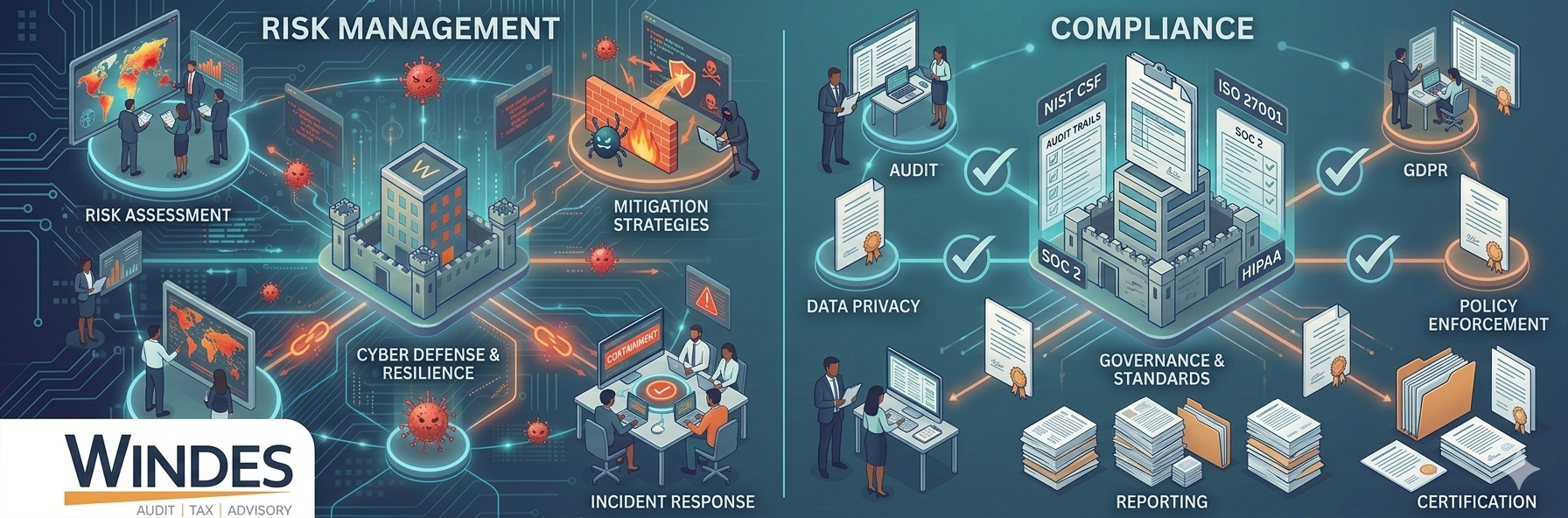
Many mid-market organizations assume that if they “pass the audit” or meet a framework requirement, they’re secure. That assumption is risky.
Compliance can be an important milestone, but compliance is not the same as cybersecurity risk management. One is primarily about meeting defined requirements. The other is about continuously identifying, prioritizing, and reducing the likelihood and impact of cyber threats based on what could actually harm your business. Understanding the difference between cyber risk management vs compliance is essential for CIOs, CROs, IT Directors, and executive teams who need a defensible approach to IT risk management and a resilient cybersecurity strategy.
In practice, growing organizations need both. Compliance helps demonstrate adherence to regulatory or industry expectations. Cybersecurity risk management helps ensure you’re not simply “secure on paper,” but measurably reducing real-world exposure, especially as your environment changes through cloud adoption, digital transformation, acquisitions, and vendor expansion.
This guide breaks down the difference between cybersecurity risk management and compliance, includes a side-by-side comparison table, provides a practical pros/cons view of each approach, and offers guidance on how to combine them into a strategy that supports growth.
COur Cybersecurity Compliance Advisory Services →
What Is Cybersecurity Risk Management?
Cybersecurity risk management is the ongoing, business-aligned process of identifying cyber threats, assessing their potential impact, prioritizing what matters most, and implementing controls that reduce risk to an acceptable level. Unlike a one-time assessment, it’s a continuous discipline that evolves as your technology, vendors, and threat landscape change.
In most organizations, cybersecurity risk management is a core component of broader IT risk management; the umbrella view of technology-related risks that includes cybersecurity, resiliency, availability, data integrity, vendor risk, and operational controls. The difference is focus: cybersecurity risk management specifically targets threats and vulnerabilities that could lead to a security incident, data exposure, ransomware event, or operational disruption.
Most importantly, cybersecurity risk management directly shapes a long-term cybersecurity strategy by aligning investments and controls to business objectives. It’s not just “more security.” It’s the right security, prioritized and measured against the risk that matters.
Key characteristics of cybersecurity risk management
- Risk identification and scoring (impact × likelihood, with business context)
- Continuous monitoring (new vulnerabilities, changes in exposure, threat activity)
- Risk tolerance alignment (what leadership accepts vs. what must be mitigated)
- Integration with enterprise risk management (ERM) and governance processes
- Executive and board reporting using clear, decision-ready metrics
What Is Cybersecurity Compliance?
Cybersecurity compliance is the process of meeting specific regulatory requirements, contractual obligations, or framework-based controls that apply to your organization. It is often defined by rules or standards such as HIPAA (healthcare-related requirements), SOC 2 (trust services criteria for service organizations), or CMMC (requirements relevant to certain government contractors), among others.
Compliance programs tend to emphasize documentation, control validation, and audit readiness. The goal is to demonstrate that required controls exist, are designed appropriately, and are operating as expected, typically within a defined audit period.
A critical distinction: compliance often represents a minimum baseline. It can be necessary and valuable, but it does not automatically equal a complete cybersecurity strategy. Organizations can be compliant and still experience significant breaches, especially if the controls implemented don’t address the highest-risk exposures in their environment.
Key characteristics of compliance programs
- Control-based frameworks (prescriptive requirements)
- Periodic audits or attestations (often annual or on an audit cycle)
- Required documentation and evidence collection
- Industry or regulatory driven scope and reporting
Cyber Risk Management vs. Compliance: A Side-by-Side Comparison
If you’re evaluating cyber risk management vs compliance, the easiest way to differentiate them is to compare goals, approach, frequency, and outcomes. Both matter, but they solve different problems.
Comparison Table: Cybersecurity Risk Management vs. Compliance
Pros and Cons of Each Approach
Cybersecurity Risk Management
Pros
- Aligns security priorities with business objectives and critical assets
- Adaptive to emerging threats and changing environments
- Supports a stronger, long-term cybersecurity strategy
- Improves executive visibility into true risk exposure (not just control status)
Cons
- Requires a mature risk methodology and consistent scoring
- May require external advisory support to establish governance and reporting
- Less “check-the-box” simplicity than framework-based compliance
Compliance-Based Approach
Pros
- Clear control requirements and structured expectations
- Provides external credibility with stakeholders (customers, partners, regulators)
- Often mandatory for doing business in certain industries or markets
Cons
- May create a false sense of security (“we’re compliant, so we’re safe”)
- Does not automatically reduce cyber risk if controls don’t match real exposures
- Can become documentation-heavy and drain limited resources
Where IT Risk Management Fits In
IT risk management is the umbrella concept that includes cybersecurity, business continuity, vendor risk, data governance, change management, and technology controls that support reliable operations. Within that umbrella, cybersecurity risk management focuses specifically on cyber threats and exposures, while compliance focuses on meeting defined requirements.
The overlap happens in governance: strong IT governance helps both approaches succeed by clarifying ownership, standardizing decision-making, ensuring controls align to business priorities, and making reporting consistent and actionable.
When governance is weak, organizations often see the same patterns: fragmented tooling, inconsistent control ownership, unclear escalation paths, and reporting that doesn’t help leadership make decisions.
Our IT Governance Advisory Services →
When Compliance Alone Is Not Enough
Compliance is necessary in many industries, but it’s not sufficient. Common scenarios where compliance-only approaches break down include:
- Passing an audit but still experiencing a breach because the audit scope didn’t cover the highest-risk exposure (e.g., identity, email security, vendor access, or misconfigured cloud systems)
- Rapid digital transformation that changes the environment faster than compliance cycles can keep up
- Expanding third-party and vendor ecosystems where suppliers and SaaS tools create new access paths and data exposure
- Evolving threat landscape where attackers adapt quickly, and controls need continuous tuning
Vendor expansion is especially important: a growing organization’s attack surface often increases through outsourced systems and integrations, not internal infrastructure.
Building an Integrated Cybersecurity Strategy
A resilient cybersecurity strategy integrates cybersecurity risk management, compliance requirements, broader IT risk management practices, and governance oversight. The objective is not to choose one and ignore the other. It’s to combine them so compliance supports risk reduction, and risk management ensures compliance doesn’t become a paper exercise.
Here’s a practical 5-step framework that scales for mid-market organizations:
- Identify Critical Assets
- Define what matters most (systems, data, revenue processes, operational dependencies) and who relies on them.
- Perform Risk Assessment
- Identify key threats and vulnerabilities, score risk in business terms, and prioritize remediation based on impact.
- Map Controls to Compliance Frameworks
- Align security controls to applicable requirements (e.g., SOC 2, HIPAA, contractual obligations), ensuring evidence is captured as controls operate.
- Monitor and Adjust Continuously
- Review risk as the environment changes (new vendors, new integrations, new services, new threat intel). Tune controls based on what’s actually happening.
- Report to Executive Leadership
- Provide leadership with actionable risk reporting: top risks, trends, remediation progress, exceptions, and decisions needed.
Short case scenario (anonymized)
A $50M California healthcare/professional services organization initially focused on compliance: annual assessments, audit evidence collection, and checklist-driven controls. After a period of rapid cloud adoption and vendor growth, leadership realized compliance alone didn’t provide visibility into real exposure, especially around identity access, vendor permissions, and incident readiness. The organization shifted to a risk-based model by implementing asset-based risk scoring, formalizing governance and reporting, strengthening vendor oversight, and mapping controls back to compliance requirements for audit efficiency. The result was a program that improved audit readiness and measurably reduced high-priority risk, without adding unnecessary complexity.
Which Is Best for Your Organization?
If your leadership team is asking “Which is best?” The most defensible answer for growing organizations is an integrated approach: cybersecurity risk management plus compliance, aligned through governance.
Decision guidance typically depends on:
- Industry and regulatory exposure (healthcare, financial services, government-adjacent contracting)
- Internal IT maturity (tools, staffing, process discipline, reporting capabilities)
- Growth trajectory (new markets, acquisitions, system changes, vendor expansion)
- Customer expectations (security questionnaires, contractual controls, audits)
If you’re heavily regulated, compliance may be non-negotiable, but risk management determines whether you’re actually reducing exposure. If you’re less regulated, compliance frameworks can still provide structure, but risk management ensures the structure addresses what truly matters.
Schedule a Technology & Risk consultation →
Frequently Asked Questions
What is cybersecurity risk management?
Cybersecurity risk management is the continuous process of identifying cyber threats, assessing potential business impact, prioritizing mitigation, and monitoring risk over time. It aligns security decisions to business objectives and helps leadership reduce the likelihood and impact of cyber incidents.
What is the difference between cyber risk management vs compliance?
Cyber risk management is risk-based and continuous, focused on reducing real-world exposure. Compliance is rules-based and periodic, focused on meeting regulatory or framework requirements. Both are important, but they serve different purposes and produce different outcomes.
Is compliance enough to protect against cyber threats?
No. Compliance can establish a baseline of controls and audit readiness, but it does not automatically reduce your highest risks. Without risk-based prioritization and continuous monitoring, organizations can remain exposed even if they pass audits.
How does IT risk management relate to cybersecurity?
IT risk management is the broader discipline that covers technology-related risks across operations, governance, vendors, and systems. Cybersecurity risk management is a subset focused specifically on cyber threats, vulnerabilities, and incident impact, while compliance is often one way to validate controls within IT risk management.
What is the best cybersecurity strategy for mid-market companies?
The strongest approach is a risk-based, governance-aligned, compliance-integrated strategy: prioritize critical assets, assess and score risk, implement controls mapped to requirements, continuously monitor and adapt, and report to leadership with decision-ready metrics.
Conclusion & Next Steps
Compliance is often necessary, but it is not sufficient. Growing organizations need executive-level cybersecurity risk management to ensure their security posture keeps pace with change, threat evolution, and third-party expansion.
A mature program integrates compliance obligations with continuous risk reduction, supported by strong IT governance and leadership reporting. That’s how organizations move from “audit-ready” to truly resilient.
Windes helps mid-market leaders build practical, scalable programs that align cybersecurity strategy, IT governance, and compliance integration, so you can reduce exposure before the next audit or incident forces the issue.